Sunday, 3 January 2016

適合夏日的方便營養早餐-免煮燕麥杯


上班前總是匆促得沒空做早餐嗎?飲食作家邱佩玲在《原味食悟2》提供超簡易的食譜,讓人人沒藉口不吃早餐。

自從開始早起為豆豆準備午餐盒後,可事先準備、不花力氣的懶人早餐,很受煮婦青睞。延續全穀、免烹調、全方位營養的概念,這個適合夏日早晨的免煮燕麥粥,和《原味食悟》裡的千層果香優格是表親,只是把當底的原味優格換成用奶浸泡過夜的燕麥片,其他就是隨喜好添加。裝對了容器,還能直接帶著走,趕上班、趕上學的人從此沒有不吃營養早餐的藉口了!

免煮燕麥杯

食材& 器具:

  1. 1 杯容量的有蓋玻璃罐
  2. 燕麥片(regular rolled oat)1/4 杯
  3. 奇亞籽1 大匙
  4. 楓糖漿或生蜂蜜1/2小匙
  5. 純天然香草精1/2小匙( 小朋友吃可免,酒精味太重!)
  6. 肉桂粉1/8小匙,或少許
  7. 填滿玻璃罐的牛奶、椰奶或自製堅果奶(約3/4 杯)

作法:

將上述食材放進玻璃罐中,混拌均勻後加蓋,睡前放進冰箱浸泡過夜。隔天一早食用前,隨興組合以下的建議食材後加入,疊上綜合水果即可。再加一顆蛋,就是全方位營養早餐了。

建議食材:

  1. 燕麥酥(granola)
  2. 磨碎的亞麻籽
  3. 漢麻籽(hempseeds)
  4. 營養酵母(nutritional yeast)
  5. 蜜蜂花粉(bee pollen)
  6. 生可可粉(raw cacao powder)
  7. 椰絲(蓉)
  8. 甜菜根粉
  9. 螺旋藻粉

廚事筆記:

(1) 基本燕麥粥甜味極幽微,得靠後加的水果來增甜。

(2) 不習慣一早吃冰涼的,可像我倒一盆熱開水,把自冰箱取出的燕麥杯直接放進熱水中回溫個10 來分鐘,吃室溫粥,等的同時洗切水果。

(3) 泡好的粥若沒及時吃完,可打顆蛋加進麵粉和泡打粉,做美式煎餅。

Tips:

可另外裝一點燕麥片加奶水泡過夜,隔天一早用果汁機打勻、加熱後,給6-8個月嬰兒吃; 10 個月以上寶寶吃的,煮熟就行,不需再打過。奇亞籽纖維質很高,有人認為可能影響貝比吸收其他營養。我覺得就算無此問題且寶寶腸胃能應付,大概也是一頭進一頭出,不如哺乳媽媽自己吃,透過母奶給孩子奇亞籽的營養。1 歲以上學步兒已開始吃成人飲食,只要量不多,吃一點泡軟的奇亞籽又何妨?

*本文摘自麥浩斯《原味食悟2》,未經同意請勿轉載

Source:
2015-12-28 00:00 更新:2018-08-10 11:20 (Source -親子天下)
by 引用自《原味食悟2》|邱佩玲


Sunday, 11 October 2015

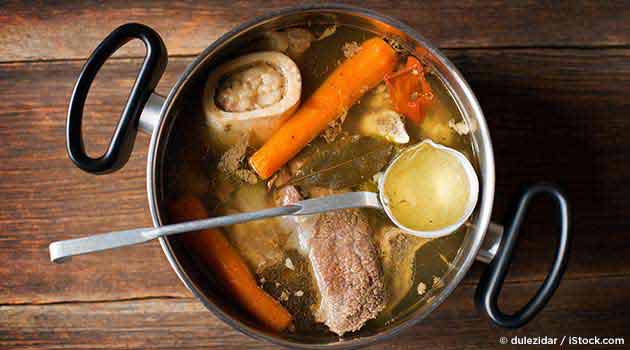
Bone Broth Recipe

Did You Know?
  • The gelatin found in bone broth is a hydrophilic colloid that attracts and holds liquids, including digestive juices, thereby supporting proper digestion
  • Bone broth reduces joint pain and inflammation courtesy of chondroitin sulfates, glucosamine, and other compounds extracted from the boiled-down cartilage
  • Amino acids such as glycine, proline, and arginine in bone broth all have anti-inflammatory effects
  • Bone broth contains high amounts of calcium, magnesium, and other nutrients that play an important role in healthy bone formation
  • Bone broth can be made from any type of bones you like – chicken, beef, pork, or even fish – but seek bones from organically raised, pastured, or grass-fed animals

Many people have memories of coming together on Sundays to share a meal with their family. If you're lucky, you may still do this today, and if you do, you know that part of the allure is waiting while the various pots simmer on the stove, filling your home with the scent of the home-cooked meal to come.

Today, I want to share with you a recipe that is the perfect complement to your Sunday meals… although really you can make it any day of the week. It's a recipe for bone broth, and it's one that is highly nourishing for both your body and your soul.

While the recipe calls for lengthy simmering (about 24-72 hours), the actual preparation time is very short, making this a meal that even those who are time-crunched can prepare. If you're fighting off a cold or the flu, homemade bone broth is excellent for speeding healing and recuperation from illness.

But far beyond this, broth or "stock" is a powerful food as it's easily digestible, helps heal the lining of your gut, and contains valuable nutrients that promote healing throughout your body.


Bone broth recipe

Bone Broth Recipe

Calories: 379 per serving Prep Time: 10 minutes Cook Time: 25 minutes
Total Time: 35 minutes Serving Size: 3 quarts

Ingredients

  • 3-4 pounds beef marrow and knuckle bones
  • 2 pounds meaty bones such as short ribs
  • 1/2 cup raw Dr. Mercola's apple cider vinegar
  • 4 quarts filtered water
  • 3 celery stalks, halved
  • 3 carrots, halved
  • 3 onions, quartered
  • Handful of fresh parsley
  • Sea salt

Procedure

  1. Place bones in a pot or a crockpot, add apple cider vinegar and water, and let the mixture sit for 1 hour so the vinegar can leach the mineral out of the bones.
  2. Add more water if needed to cover the bones.
  3. Add the vegetables bring to a boil and skim the scum from the top and discard.
  4. Reduce to a low simmer, cover, and cook for 24-72 hours (if you're not comfortable leaving the pot to simmer overnight, turn off the heat and let it sit overnight, then turn it back on and let simmer all day the next day)
  5. During the last 10 minutes of cooking, throw in a handful of fresh parsley for added flavor and minerals.
  6. Let the broth cool and strain it, making sure all marrow is knocked out of the marrow bones and into the broth.
  7. Add sea salt to taste and drink the broth as is or store in fridge up to 5 to 7 days or freezer up to 6 months for use in soups or stews.

The Healing Benefits of Bone Broth for Your Gut

Bone broth is a staple of the GAPS Diet, which is based on the Gut and Psychology Syndrome (GAPS) principles developed by Dr. Natasha Campbell-McBride.

The GAPS diet is often used to treat children with autism and other disorders rooted in gut dysfunction, but just about anyone with allergies or less than optimal gut health can benefit from it, as it is designed to heal leaky gut.

If your gut is leaky or permeable, partially undigested food, toxins, viruses, yeast, and bacteria have the opportunity to pass through your intestine and access your bloodstream; this is known as leaky gut.

When your intestinal lining is repeatedly damaged due to reoccurring leaky gut, damaged cells called microvilli become unable to do their job properly. They become unable to process and utilize the nutrients and enzymes that are vital to proper digestion.

Eventually, digestion is impaired and absorption of nutrients is negatively affected. As more exposure occurs, your body initiates an attack on these foreign invaders. It responds with inflammation, allergic reactions, and other symptoms we relate to a variety of diseases.

Leaky gut is the root of many allergies and autoimmune disorders, for example. When combined with toxic overload, you have a perfect storm that can lead to neurological disorders like autism, ADHD, and learning disabilities.

The GAPS diet starts out as an elimination diet, which means taking out all inflammatory foods. This includes high-fiber foods, processed foods, and anything that is going to be difficult to digest.

One of the main foods that you use is bone broth, because not only is it very easily digested, it also contains profound immune-optimizing components that are foundational building blocks for the treatment of autoimmune diseases.

As your leaky gut begins to heal and your health improves, certain foods are added back in, but bone broth remains a staple because it is so incredibly nourishing for your body. This is why, even if you don't have gut issues, it is still a wonderful staple food to include in your diet.

Top Reasons to Eat Bone Broth

There are many reasons for incorporating good-old-fashioned bone broth into your diet. The following health benefits attest to its status as "good medicine."

Helps heal and seal your gut, and promotes healthy digestion: The gelatin found in bone broth is a hydrophilic colloid. It attracts and holds liquids, including digestive juices, thereby supporting proper digestionInhibits infection caused by cold and flu viruses, etc.: A study published over a decade ago found that chicken soup indeed has medicinal qualities, significantly mitigating infection1
Reduces joint pain and inflammation, courtesy of chondroitin sulphates, glucosamine, and other compounds extracted from the boiled down cartilageFights inflammation: Amino acids such as glycine, proline, and arginine all have anti-inflammatory effects.

Arginine, for example, has been found to be particularly beneficial for the treatment of sepsis2 (whole-body inflammation). Glycine also has calming effects, which may help you sleep better
Promotes strong, healthy bones: Bone broth contains high amounts of calcium, magnesium, and other nutrients that play an important role in healthy bone formationPromotes healthy hair and nail growth, thanks to the gelatin in the broth

Choose High-Quality Bones from Grass-Fed Animals

The recipe that follows is from The Heal Your Gut Cookbook: Nutrient-Dense Recipes for Intestinal Health Using the GAPS Diet. Written by Hilary Boynton and Mary Brackett, it shares helpful tips on how to "heal and seal" your gut so that profound healing can take place.

Hilary Boynton is a local food advocate and a certified holistic health counselor who runs several local food co-ops and teaches cooking classes out of her home. Mary Brackett is a photographer and whole foods advocate who seeks out projects that illustrate the importance of healthy choices.

This bone broth recipe is a classic and one you'll want to keep for future reference. Below I've also included tips on how to make this recipe using a slow cooker or different types of bones, such as chicken. Perhaps the most important caveat when making broth, whether you're using chicken or beef, is to make sure the bones are from organically raised, pastured or grass-fed animals.

As noted by Sally Fallon, chickens raised in concentrated animal feeding operations (CAFOs) tend to produce stock that doesn't gel, and this gelatin has long been valued for its therapeutic properties.3 As noted by Boynton:

"You definitely want to get the best bones you can get—bones from pastured animals. If you can't find a farmer in your area, reach out to your local Weston A. Price chapter leader... There are also resources to get homemade bone broth if you can't make it yourself. ...If you can only get CAFO bones, I guess you go with that. You can still get some healing benefits. But it would be better to go with bones from pastured animals."

A Basic Bone Broth Recipe

The recipe that follows calls for beef bones, but you can also make bone broth using whole organic chicken, whole fish (including the head) or fish bones, or pork. Each will render a different flavor. Boynton and Brackett actually suggest starting with chicken because it has the mildest flavor (beef tends to be more overpowering). If you're using chicken, simply place the entire chicken, raw, into the pot in place of the beef bones and proceed with the recipe as follows.

One note, if cooking a whole chicken, the meat should start separating from the bone after about 2 hours. Simply remove the chicken from the pot and separate the meat from the bones. Then place the bones back in and continue to simmer. You can even use bones from a roasted chicken or turkey carcass to make bone broth, which is incredibly cost effective since you would otherwise throw them away.

How to Make Bone Broth Using Your Slow Cooker

Bone broth is an example of a traditional food that's easily adaptable to your modern lifestyle. Even if you're away from home most of the day, you can still prepare homemade bone broth by using a slow cooker. To use a slow cooker, you will need to first bring the broth to a boil in a pot on your stove, then skim the scum off the top. Pay careful attention to this stage, as once the broth begins to boil the scum is rolled right back into the broth. The scum are the impurities that you want to remove. You can then transfer the broth to your slow cooker and turn it on to low heat for 24 to 72 hours.


Source:

Recipe From Boynton and Brackett  |  Date Published: May 10, 2014 

Thursday, 3 May 2012

Must-avoid refined foods


What are refined foods?
Refined foods are highly processed foods that have been stripped of their original nutrient content and fibre. Refined white flour, white pasta, and white sugar are just some examples.

Consider a loaf of sliced white bread. First, the wheat is stripped of bran and fibre, and then it's pulverised into the finest white flour. The baking process puffs it up into light, airy slices of bread. No wonder your stomach makes such quick work of it. A slice of white bread hits your bloodstream with the same jolt you'd get by eating a tablespoon of sugar right from the bowl!
Genuine 100-per cent whole-wheat or whole-grain bread, on the other hand – the coarse, chewy kind with a thick crust and visible pieces of grain – puts your stomach to work. It too is made of wheat, but the grains haven't been processed to death. It contains starches, which are just chains of sugars, but they are bound up with the fibre, so digestion takes longer. As a result, the sugars are released gradually into the bloodstream. If there's no sudden surge in blood sugar, your pancreas won't produce as much insulin, and you won't get the exaggerated hunger and cravings for more sugary and starchy carbs.

The following should be avoided or consumed only occasionally:

  • White bread
  • Crackers
  • Cookies (or any baked goods made with white flour or refined wheat flour)
  • Instant oatmeal
  • Rice cakes
  • White pasta
  • White rice

Source:

By - TNNCreated: Apr 12, 2011, 00:00 IST | TimesofIndia | Unhealthy food photo created by wayhomestudio - www.freepik.com

Saturday, 13 November 2010

Lemon Ginger Shot


When I catch a cold, I don't take any medicine/pills. I typically harvest juice from lemon and ginger and add some Sabah wild honey. 

It works for me most of the time. Of course, I need to drink a lot of water to ensure I'm not dehydrated and get some rest. 

Saturday, 6 June 2009

Recommended Movie: Food Inc

電影介紹:

這是一部以我們日常生活的飲食習慣裏最常、最愛的快餐作爲開端的電影。

比如,我們最愛吃的炸鷄:從一只鷄從誕生到進入超市的周期只有48天,包括小鷄們從小就被打針、在什麽環境成長、多少只是成功從鷄場到桌上……等等。

基本上,它是在告訴我們,我們的快餐原料來源都是大量生產的。而爲了大量生產、賺取高額利潤,不惜改變動植物的生長方式和周期,甚至環境。而之中的代價都是我們這些消費者的健康和安全,甚至犧牲掉環境………………

那種殘酷的程度,真的令人乍舌、慘不忍睹。


Source:
An unflattering look inside America's corporate-controlled food industry.
Director: 
Robert Kenner
Writers: Robert Kenner,Elise Pearlstein, Kim Roberts
Stars: Michael Pollan,Eric Schlosser,Richard Lobb

Sunday, 15 August 2004

Tokyo Journal; When Doctor Won't Tell Cancer Patient the Truth

When Emperor Hirohito began to vomit inexplicably and then lost weight and energy, his doctors never told him what just about everyone else in Japan eventually came to know: He was dying of cancer.

Hirohito may have been a virtual god in the early part of his reign, but he was also a patient -- and doctors in Japan mostly lie to cancer patients, even former divinities. "I don't regret that I didn't tell him about his cancer," Akira Takagi, the Emperor's chief doctor, said at the time of Hirohito's death in 1989.

But these days, a mild-mannered radiologist is crusading for the principle of telling patients the truth, even when that means breaking their hearts.


The radiologist, Dr. Makoto Kondo, returned from a year in the United States determined to tell patients bad news, and his campaign for radical change -- for pulling doctors down a notch and injecting democracy into the Japanese medical system -- is provoking such outrage among fellow physicians that they refuse to refer patients to him. He is scarcely more polite about them.

"The present system is like the medical experiments on prisoners during World War II," Dr. Kondo said as he took a break in his cluttered office, surrounded by books in Japanese and English. "It's a very awful thing. It's a shame."

Dr. Kondo's latest book, "Side Effects of Anti-Cancer Drugs," has hit several best-seller lists since it arrived in bookstores late last year. Patients flock to his practice, and he has become about as much of a celebrity as a full-time radiologist can.

Surveys suggest that only about a quarter of Japanese doctors always tell patients when they have cancer. People are especially unlikely to be told if they have inoperable cancers with a poor prognosis; patients with stomach cancer may be told they have nothing more than an ulcer.

A 50-year-old woman named Kazuko Makino was told that she had gallstones, even though her doctor suspected gallbladder cancer. The doctor recommended surgery, but Mrs. Makino was a nurse and decided that she did not need an operation to remove her "gallstones."

The cancer spread, and Mrs. Makino died. Her family sued the hospital for malpractice, but a court rejected the claim, ruling in a landmark case in 1989 that doctors need not tell cancer patients their true condition.

Japanese doctors do not disclose bad news primarily because of fear that it would upset the patient and harm the prognosis. Neither side can cite statistics about whether patients live longer if they have been lied to, but even some of those who favor honesty worry about the psychological and physiological consequences if a doctor is seen as pronouncing a death sentence.

Dr. Kondo acknowledges that he used to go along with this.

"I didn't tell patients the truth," he said. "I lied to them. But it was a very bad experience."

Dr. Kondo was also greatly affected by a year he spent in the United States, in 1979. "I realized that if a doctor could tell the truth to patients in the U.S.," he said, "then I could do the same to patients in Japan."

The best gauge of what Dr. Kondo is up against is the popularity of an anti-cancer drug called Krestin. Its manufacturer says Krestin sales amount to about $100 million a year.

It is said to be popular because doctors can prescribe it without telling patients that they have cancer. Krestin is taken orally, and does not have debilitating side effects that might give patients clues to the diagnosis.

But critics assert that Krestin does not have much in the way of good effects either. The Japanese Hospital Association has condemned the drug, saying doctors wasted $10 billion on it and another anti-cancer drug.

Sankyo Pharmaceuticals, which sells Krestin, takes a different view. "We consider it effective, in that the Ministry of Health and Welfare conducted a review and permitted its use," said a company spokesman.

Dr. Masanori Fukushima, a cancer specialist who is critical of Krestin, said, "Things happen in this country which are ridiculous." Still, Dr. Fukushima and everyone else interviewed said the number of doctors who tell the truth to patients is greater than it was five years ago.

"It's a process of democracy developing in the health system," Dr. Fukushima said. "We're about 20 or 30 years behind the United States."

The authoritarian, paternalistic elements in the current Japanese health care system are evident even in a checkup. Japanese doctors are less likely than American ones to explain what they are doing and why, or to indicate what they have found.

Moreover, Japanese prescription bottles do not state the medicine being taken. Instead, there are symbols that a patient can decipher by consulting a technical reference that has been a huge best seller in Japan.

"The relationship between the physician and the patient is like that between God and the people," said Dr. Masao Miyamoto, a psychiatrist who earned his medical degree in Japan and later taught and practiced in the United States. "The problem then is that in Japan a patient can't get a second opinion. It becomes an insult."

Underlying the dispute about telling patients the truth is a conflict among lay people about what the policy should be. A poll last year found that 64 percent of those interviewed would want to be told the truth if they had cancer. But when asked their opinion if the patient was another family member, 58 percent said they would not want the doctor to tell the truth to their loved ones.

"A majority of family members are against telling the truth to the patient, at least initially," said Dr. Mitsuru Sasako, a professor of surgery at the National Cancer Center Hospital in Tokyo. Dr. Sasako said that he normally tells patients the truth anyway, but that it must be done with special care in Japan because there are none of the support organizations that exist in America to counsel terminally ill patients.

Dr. Sasako argues that Dr. Kondo's advice to the public was initially useful in shaking up the medical establishment. But like most doctors, he said Dr. Kondo's pronouncements are now too sweeping and opinionated and leave patients skeptical and uncertain about their options.

"If he makes people unable to believe doctors, that can make patients unhappy," he said. "If Dr. Kondo makes too many accusations, that causes confusion among patients."


Source:
By Nicholas D. Kristof   
Feb. 25, 1995
A version of this article appears in print on Feb. 25, 1995, Section 1, Page 4 of the National edition with the headline: Tokyo Journal; When Doctor Won't Tell Cancer Patient the Truth.

Wednesday, 21 August 2002

Malaysia bans cancer-risk soy sauce


Cooked food stall in Malaysian market
Soy, oyster and prawn sauces are popular in oriental cooking
Malaysia's food standards agency has blocked the sale of more than 20 types of soy sauce and other popular cooking sauces because they contain unsafe levels of 3-MCPD, which can cause cancer.

The cooking sauces - many of them brands which are widely sold internationally - failed tests set by the British Foods Standards Agency (FSA) as they contained more than 20 parts per billion of 3-MPCD.

The FSA issued a warning to consumers about cancer-risks from soy sauce in June 2001 after testing 100 samples, of which 22 gave cause for concern.

In July, Malaysia's health ministry seized and destroyed 4,339 bottles of sauce worth 9,204 ringit (£1,687, $2,424) from 22 brands.

New sauce recipes

Further testing has now led to bans on 25 sauces -16 locally-made and nine imported - according to the Star newspaper.

Manufacturers will have to revise their recipes before being allowed to sell their products in Malaysia.

"The reviewed formula has to be submitted to the FQCD for confirmation before they are allowed to be sold," the ministry said.

The seized sauces were mostly manufactured in Thailand, China, Hong Kong and Taiwan. Most of the sauces were soy-based but bottles of oyster sauce and prawn sauce were also removed from markets.

International brands

The ministry has now adopted the British FSA's testing standard, together with a new system of certification, and notified the World Trade Organisation of its criteria.

The report did not specify which had been found to contain dangerous levels of 3-MCPD. Although the brands involved are internationally-recognised names, the bottles involved could be counterfeits.

The Universiti Sains Malaysia is carrying out tests on 508 products on behalf of the FQCD, and has checked nearly 400 so far.

Source:
Malaysia bans cancer-risk soy sauce
Wednesday, 15 August, 2001, 16:03 GMT 17:03 UK